
AI-Powered Reconciliation Software to Accelerate Your Financial Close
Download the Accountant’s Guide to Reconciliations and discover how finance leaders are accelerating the close, reducing risk, and unlocking time for strategic priorities.

Trusted by:




















4 Steps to an Accurate and Efficient Account Reconciliation Process
Finance leaders know that reconciliations are critical to financial integrity. Yet, manual processes consume valuable time, expose organizations to risk, and limit visibility. This guide, developed by CFO Dive and Trintech, gives you a proven framework to transform reconciliations into a driver of efficiency, compliance, and strategic value.
This Account Reconciliation Guide from CFO Dive and Trintech will discuss:
- Defining policies for account reconciliations
- Standardizing workflows
- Establishing risk ratings
- Automating with AI-powered reconciliation software
Download the guide to learn more.
The Accountant's Guide To Reconciliations
Redefining the Close with Reconciliation Software
The Accountant’s Guide to Reconciliations provides finance leaders with a practical, four-step framework to transform the close process. By applying these best practices, you’ll reduce risk, standardize operations, and unlock the full potential of automation. This guide equips you with the strategies and tools needed to deliver consistency, compliance, and confidence across the entire reconciliation process.
Define Policy & Processes
Reconciliations without governance create inconsistency and exposure to risk. Establishing clear, documented policies lays the foundation for stronger controls and ensures alignment with auditors. When paired with modern reconciliation software, these policies provide transparency and accountability, reinforcing internal controls.
Standardize Across the Organization
Many organizations reconcile differently across regions, ERPs, or business units—creating inefficiencies and errors. By unifying templates and workflows, finance leaders ensure consistent account reconciliation practices worldwide. Standardization drives accuracy, improves audit readiness, and gives finance teams confidence in their close.
Establish Risk Ratings
Not every account requires the same frequency of review. A risk-based approach—monthly for high-risk, quarterly for medium-risk, and annually for low-risk accounts—enables teams to prioritize resources where they matter most. With the support of advanced reconciliation solutions, this strategy strengthens compliance, reduces unnecessary workload, and sharpens focus on high-value exceptions.
Leverage Automation
Manual reconciliations are a bottleneck. Today’s automation technology eliminates repetitive tasks, accelerates reporting, and provides real-time visibility into reconciliation status and exceptions. By leveraging AI-enabled reconciliation solutions, finance leaders can achieve a faster close, improve accuracy, and free up talent for higher-value strategic work.
Measurable Returns on Reconciliations
- 90% Reduction in Number of Accounts to Be Reconciled
- 95% Reduction in Time Creating Management Reports
- 99% Reduction in Preparation Time on Reconciliations
- 60% Reduction in Time to Support External Auditors
Why Reconciliations Demand Change
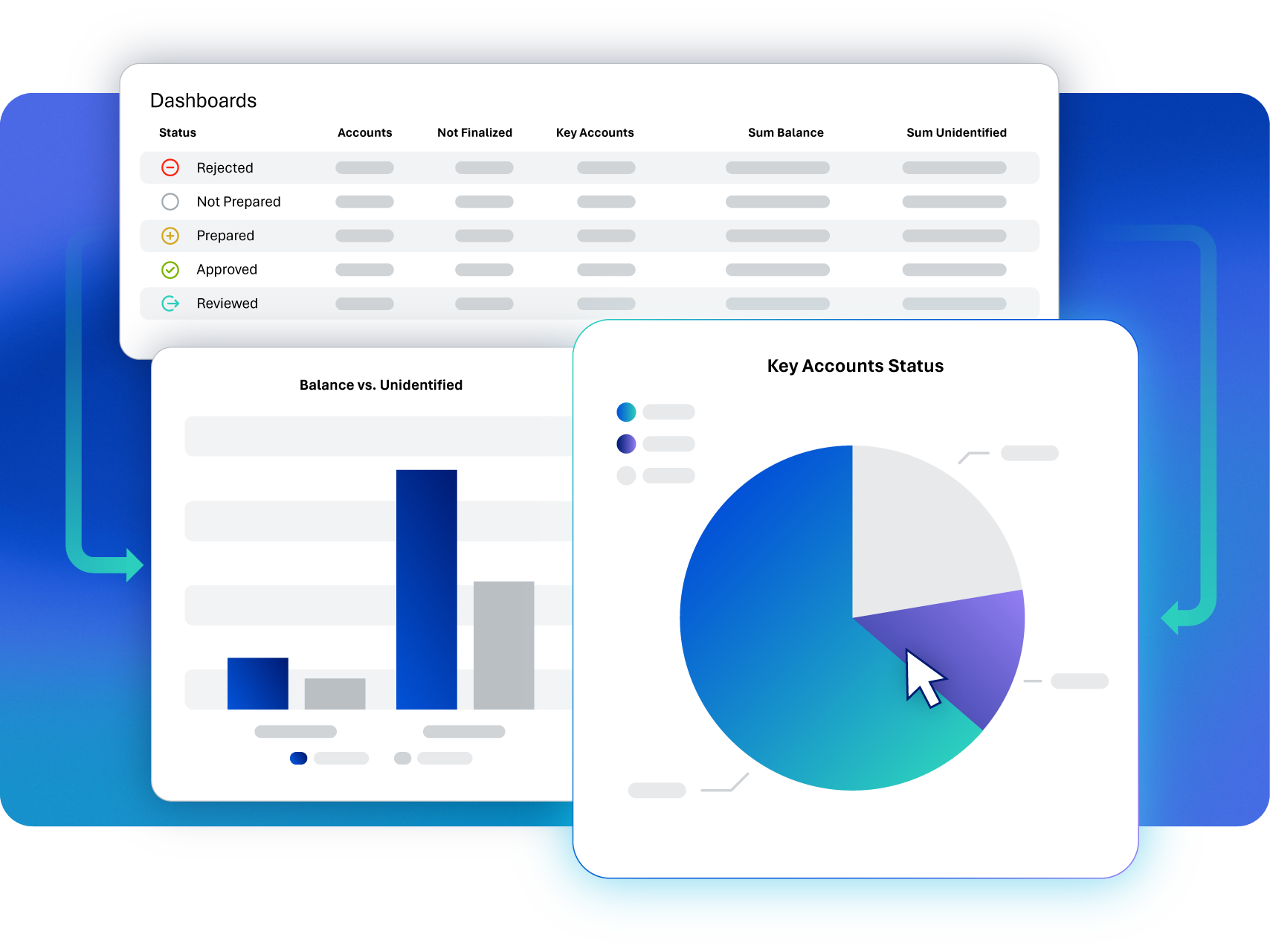
For most organizations, the account reconciliation process remains the single most time-consuming and frustrating part of the close. Manual spreadsheets, disconnected ERPs, and inconsistent practices create inefficiencies, expose the balance sheet to risk, and delay reporting.
CFOs and Financial Controllers face three persistent challenges:
- Operational Inefficiencies: Manual account reconciliations limit scale, drain resources, and extend the close.
- Limited Visibility: Fragmented processes make it difficult to manage balance sheet risk and track exceptions in real time.
- Compliance Risk: Weak controls increase audit exposure and heighten the risk of material misstatement.
By adopting modern reconciliation software, finance leaders not only reduce risk and accelerate reporting—they also free capacity for their teams to focus on analysis, forecasting, and delivering strategic insight to the business.
“We have high volumes of reconciliations within our bank accounts, so Trintech’s solution has been a game changer. When it comes to our month-end close processes, the solution helps me see potential bottlenecks and monitor my team’s workload, allowing me to get ahead of problems before they arise. This reduces the stress on the team as well as ensures that we’re maximizing efficiency and getting everything accomplished on time.”
Accounting Team Lead

“Trintech’s solution provides us with a percentage of completion that clearly communicates what’s finished and what is remaining. We really didn’t have any good metrics related to our financial close process prior to Trintech. Now, our Controller can see the total amount of reconciled items for any point in time and how material those reconciliations were to our financial statements.”
Lead Accountant

“Prior to Trintech, our reconciliations were in Excel. Processes were very manual with no built-in workflows or approvals. After Trintech, we started focusing on quality improvements with automation and our processes are now best-in-class.”
Senior Financial Analyst
“Today, we are loading about 100,000+ records and auto-reconcile over 90% of those intercompany reconciliations, which has been a significant win for us.”
Financial Systems Support

“Trintech’s solution has allowed our company to be able to streamline our business processes. It's also allowed us to complete our reconciliations faster. This has obviously allowed work life balance, to create more efficiencies with our teams and with our weekly processes, and to be able to create great efficiencies between our teams.”
Regional Controller
The Future of Finance: AI-Driven Reconciliations
AI is reshaping how CFOs and Controllers approach the reconciliation process. With AI-powered matching, anomaly detection, and predictive insights, leaders gain more than efficiency—they gain foresight.
With modern AI-enabled reconciliation software, you can:
- Identify issues before they create risk – spot anomalies in balance sheet reconciliations in real time
- Predict discrepancies – leverage AI models to forecast where reconciliation challenges will occur
- Streamline exception handling – resolve breaks faster with automated insights and suggested actions
- Deliver audit-ready transparency – provide auditors with a clear, traceable view of every account reconciliation
Forward-looking finance leaders are already utilizing AI-powered reconciliation solutions in their close processes. By doing so, they’re reducing risk, accelerating close cycles, and empowering their teams to focus on delivering strategic value
FAQ: Trintech’s Account Reconciliation Software
What role does AI play in Trintech’s reconciliation solutions?
Trintech’s AI capabilities identify anomalies, predict reconciliation issues, and streamline exception handling. This gives CFOs and Controllers greater foresight, reduces write-offs, and provides auditors with complete transparency into every account reconciliation.
Will Trintech’s reconciliation software work across multiple ERPs and business units?
Yes. Trintech is built for complex, global organizations. Whether you operate across multiple ERPs, currencies, or regions, Trintech’s reconciliation solutions standardize processes, unify templates, and deliver consistency across your entire enterprise.
How does Trintech’s account reconciliation software improve the close process?
Trintech’s account reconciliation software reduces the manual workload for finance teams by automating repetitive tasks such as matching transactions, certifying low-risk accounts, and preparing reconciliations. Users gain real-time visibility into reconciliation status, fewer errors to fix at month-end, and more time to focus on investigating exceptions instead of chasing spreadsheets.