
Intercompany Accounting Basics

What is Intercompany Accounting?
Large organizations often have subsidiaries that conduct business with one another. Such business activity falls outside the bounds of traditional business, and specific rules govern how such transactions are accounted for. The process is called “intercompany accounting,” and it applies not only to multinational corporations but to mid-size companies as well. In this post, we’ll answer the question: what is intercompany accounting?
Recommended Content
Understanding Intercompany Transactions: Types, Examples, and Accounting Considerations
Intercompany Accounting Best Practices: 6 Ways to Improve Accuracy and Efficiency
How to Choose Intercompany Accounting Software
What Is Intercompany Accounting and Why Is It Important?
Intercompany accounting exists to neutralize the potential impact of internal transactions on a company’s bottom line, thereby producing financial statements and filings that only reflect business activity conducted with 3rd parties. The result is a clear picture of a company’s actual income and expenses, not a picture sullied by what are effectively internal transactions that do not produce any gross or net financial gain or loss for the company.
Think of companies with various locations or subsidiaries in terms of a family. When the parent gets a check from an employer, new money enters the family financial ecosystem. However, when the parent gives some of that money to one or more of their children that is the equivalent of an intercompany transaction because no new money has entered the family’s financial ecosystem. This is also the case if one child gives money to their sibling: one sibling will have more money and one less, but no new money has entered the family’s financial picture. It’s just the parent’s income being moved about.
In a nutshell, intercompany accounting ensures a company does not claim sales or purchases it makes to or from itself on the financial statements it provides to tax authorities, regulators, investors, or other stakeholders. Beyond keeping things on the straight and narrow, intercompany accounting helps businesses:
- Gain a clear picture of financial activity between entities owned by the parent company.
- Eliminate duplicate counting of intercompany financial activity.
- Ensure the accuracy of tax filings.
- Ensure compliance with accounting and reporting standards.
If intercompany accounting did not exist, companies could unintentionally provide an unclear financial picture to stakeholders. In the worst-case scenario, they could attempt to defraud investors, shareholders, and tax authorities by painting an inaccurate picture of company income, profit, or loss.
What Are Examples of Intercompany Accounting?
Intercompany accounting comes into play whenever one entity within a corporate group conducts business with another entity in the same organization. Although each subsidiary records the transaction in its own books, the transaction must ultimately be eliminated during consolidation because the company cannot recognize revenue or expenses from doing business with itself.
For example, imagine a parent company owns two subsidiaries:
- Subsidiary A manufactures products.
- Subsidiary B distributes those products to customers.
When Subsidiary A sells $100,000 of inventory to Subsidiary B, both companies record legitimate accounting entries. Subsidiary A records revenue, while Subsidiary B records a purchase. However, from the perspective of the parent company, no external sale has occurred because the transaction happened entirely within the organization.
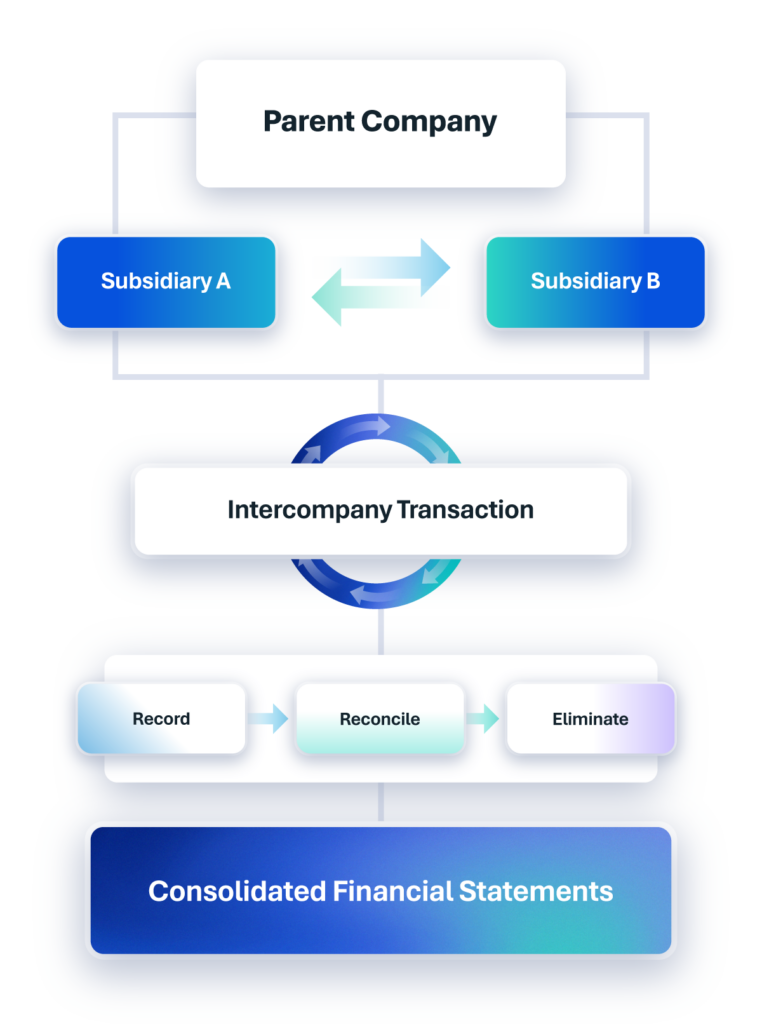
During the financial close, accountants reconcile both sides of the transaction and eliminate the corresponding revenue, expense, receivable, and payable balances so the consolidated financial statements reflect only transactions with third parties.
Other common examples of intercompany transactions include:
- Shared service charges between business units
- Management fees
- Intercompany loans
- Cost allocations
- Royalty payments
- Transfers of inventory or fixed assets
As organizations grow through acquisitions or global expansion, these transactions become more frequent and more complex, making standardized processes and automation increasingly important.
Risks Associated with Intercompany Transactions
If intercompany accounts are not settled in a timely fashion, it can lead to a multitude of issues including unpredictable cash flow, discrepancies during audits, and, of course, fraud. If a subsidiary is in a different tax jurisdiction than the parent, slow accounting of intercompany transactions greatly increases the risk of tax penalties and increased scrutiny by tax enforcement agencies like the IRS and HMRC. If investors or shareholders become aware of fraudulent accounting practices between companies, it may result in legal action, penalties, and a sharp decline in stock value.
On the other hand, diligent, accurate intercompany accounting can mitigate the risk of fines and lawsuits and provide company leaders with accurate information on which to base budgets and financial projections.
Common Intercompany Accounting Challenges
Intercompany accounting sounds straightforward in theory, but it can quickly become one of the most time-consuming parts of the financial close. As organizations add subsidiaries, operate across multiple countries, or rely on different ERP systems, the number of intercompany transactions can increase dramatically.
Some of the most common challenges include:
High transaction volumes
Large organizations may process thousands—or even millions—of intercompany transactions every month. Managing that volume manually can overwhelm finance teams and delay the close.
Timing differences
One entity may record a transaction before the corresponding entity records its side of the entry, creating temporary mismatches that require investigation before financial statements can be finalized.
Multiple ERP systems
Companies that have grown through acquisitions often operate multiple ERP instances or accounting systems. Differences in account structures, currencies, and business processes make matching transactions much more difficult.
Manual reconciliation
Many finance teams still rely on spreadsheets, email, and manual journal entries to identify and resolve differences. These processes are slow, difficult to audit, and prone to human error.
Global compliance requirements
Organizations operating internationally must also account for different tax regulations, currencies, transfer pricing rules, and local reporting requirements, adding another layer of complexity to intercompany accounting.
Fortunately, many of these challenges can be reduced through standardized processes, strong governance, and automation that helps identify mismatches earlier in the close process.
Learn more about intercompany accounting challenges and how to manage them.
Principles of Intercompany Accounting
If a company with subsidiary units wants to maintain a good reputation with investors, regulators, and tax authorities, they should adhere to these three core principles in its intercompany accounting:
Establish governance: Parent company policies for intercompany accounting should include oversight, clear remedial steps, and performance metrics to ensure standardization and the reduction of errors.
Ensure accountability: For effective intercompany accounting, assign tasks to specific team members and hold them accountable. Centralized control promotes consistency and prevents delays in closing.
Automate: Intercompany accounting software can help streamline the process and reduce the manual effort required by automating many of the repetitive tasks. This allows your accounting team to focus on more valuable tasks, leading to improved efficiency and accuracy in your processes.
Intercompany Accounting Best Practices
The goal of intercompany accounting should be to ensure compliance and maintain your organization’s financial reputation. Here are the intercompany accounting best practices that ensure those outcomes:
Flag transactions immediately: Labeling transactions at their inception instead of later dramatically reduces the odds that these transactions will slip through the cracks. Intercompany accounting software can flag intercompany activity automatically and prevent delays in the financial close process.
Eliminate intercompany transactions immediately: Once intercompany transactions are identified, software controls can be used to eliminate them automatically. Doing so further reduces the need for accountants to intervene manually and limits the number of top-side adjustments the parent company makes on its consolidated financial statements.
Settle all intercompany accounts on a monthly basis: Settling intercompany accounts at the end of each month can prevent errors, confusion, and unclear financial statements, and help company leaders make informed decisions.
Invest in intercompany accounting software: Investing in technology, such as Trintech’s intercompany accounting solution, can significantly improve the entire intercompany transaction reconciliation process in terms of efficiency and accuracy.
Opt for continuous closing: Manage intercompany accounting workflows efficiently by handling closing tasks on a daily basis. This avoids delays and simplifies reconciliation by enabling accountants to investigate incidents while the details are still fresh in their minds.
Manage access and roles: With intercompany transactions, involve fewer parties and define their roles clearly to manage access efficiently.
Implement fixed asset management: Intercompany transactions often involve transferring fixed assets between units. Trintech’s intercompany accounting solution manages fixed assets and depreciation history to ensure nothing gets overlooked during the transfer.
Conclusion
Having accurate and timely intercompany accounting is crucial in ensuring compliance and maintaining accurate financial reporting. Trintech’s intercompany accounting solution simplifies the process, reduces errors, eliminates bottlenecks during the close, and helps your team generate more accurate financial statements.
To find out more about how Trintech can help your intercompany accounting, click here.
Frequently Asked Questions About Intercompany Accounting
What is the purpose of intercompany accounting?
The purpose of intercompany accounting is to accurately record and eliminate transactions between entities within the same corporate group so consolidated financial statements only reflect transactions with external parties.
What are intercompany transactions?
Intercompany transactions are financial activities between related legal entities under the same parent company, including sales of goods, shared services, loans, management fees, royalties, and cost allocations.
Why is intercompany accounting difficult?
Intercompany accounting becomes challenging when organizations manage high transaction volumes across multiple entities, ERP systems, currencies, and tax jurisdictions. Manual reconciliation and timing differences often create mismatches that slow the financial close.
What is the difference between intercompany accounting and intercompany reconciliation?
Intercompany accounting is the broader process of recording, managing, and eliminating transactions between related entities. Intercompany reconciliation is one step within that process, focused on ensuring both sides of each transaction agree before consolidation. Read our blog for a deeper dive on this topic.
What is an intercompany elimination?
An intercompany elimination removes the financial impact of transactions between entities within the same corporate group during consolidation, preventing revenue, expenses, assets, or liabilities from being counted twice.
Can ERP systems manage intercompany accounting?
Many ERP systems provide basic intercompany functionality, but organizations with large transaction volumes or multiple ERP environments often use dedicated intercompany accounting software to automate reconciliation, settlement, and eliminations while improving visibility and control.
Learn more in our Finance & Accounting Glossary