
Trintech’s Agentic AI for Financial Close
From variance investigation to exception prioritization and accrual accuracy, Trintech’s AI agents help finance teams shift time out of manual execution and into oversight, judgment, and action.
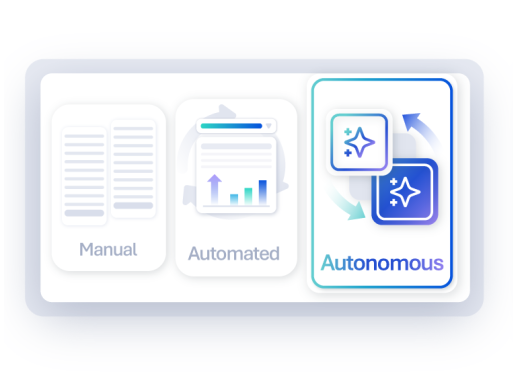
A new model for how finance work gets done
The future of finance is not just faster workflows. It is a better division of labor between finance professionals and AI.
Trintech’s agentic AI is designed to take on high-effort finance work that consumes time, slows review, and creates inconsistency when done manually. Instead of spending hours investigating changes, sorting exceptions, or correcting accruals, teams review AI-generated outputs, make decisions faster, and stay focused on what requires finance judgement.
Agents that execute the work of close anywhere
Trintech Variance Analysis Agent
Analyzes balances across periods, identifies material changes, explains likely drivers, and directs review to the accounts and movements that matter.
- Automated identification of material variances
- AI-assisted anomaly detection and business driver analysis
- Reviewer-ready narrative generation with supporting evidence
- Guided investigation and review
- Audit-ready variance documentation

Trintech Flux Agent
Modernizes account fluctuation analysis by helping accounting teams identify meaningful changes earlier, validate balances faster, and improve confidence in financial reporting.
- Automated identification of material account movements
- Period-over-period balance analysis across entities, currencies, and reporting hierarchies
- AI-assisted anomaly detection
- AI-generated fluctuation explanations and narrative generation
- Supporting evidence collection and documentation
Trintech Exception Management Agent
Detects, classifies, and prioritizes exceptions across transaction matching and reconciliation.
- Replaces manual sorting and triage
- Creates a prioritized, ready-to-act workload
- Reduces exception backlogs and improves resolution speed
Trintech Accruals Intelligence Agent
Modernizes accrual management by helping accounting teams generate and roll forward estimates faster, apply consistent calculation methodologies, and improve accuracy, governance, and audit readiness.
- Automated accrual generation and roll-forward of continuing balances
- Consistent calculation methodology across entities, cost centers, currencies, and reporting hierarchies
- AI-assisted identification of estimates outside historical trends and expected ranges
- Automated identification and tracking of true-ups and reversals
- Documented calculation methodology, supporting evidence, reviewer signoffs, and complete audit trails

Trintech Data Access Agent
Modernizes financial data access by helping finance and IT teams connect hard-to-reach sources, automate data retrieval and transformation, and improve visibility, governance, and trust in the data underlying the close.
- Centralized data retrieval across cloud, on-premise, login-only, MFA-gated, API, and no-API sources
- Automated data cleaning, mapping, transformation, and delivery to downstream systems
- Destination-agnostic governed pipelines supporting Cadency, Adra, ReconNET, and the broader Trintech AI Platform
- End-to-end visibility into data lineage, transformations, failures, and required actions
- Self-managed connections with traceable, auditable processes and supporting documentation
What finance organizations gain
With Trintech’s agentic AI, finance organizations:

Shift from manual investigation to intelligent review

Eliminate exception triage as a bottleneck

Improve the quality and consistency of accruals and explanations

Reduce cycle time without sacrificing control

Identify risk earlier and act before issues escalate

Reduce pressure late in the close cycle

Create more capacity for analysis, decision-making, and business support
What makes Trintech’s agents different

Workflow execution, not task suggestion
Agents complete finance work end-to-end instead of requiring users to interpret prompts or assemble outputs manually

Explainable, audit-ready outputs
Every result is transparent, reviewable, and suitable for audit and compliance requirements

Human-in-the-loop control by design
Finance professionals remain accountable, with clear review and approval points

Continuous improvement from real finance activity
Agents learn from how teams match, reconcile, and resolve work, improving accuracy over time
Usable across any finance environment
Agents operate across the Trintech platform or alongside ERP systems and third-party tools
Trintech’s agentic AI: from tasks to workflows to autonomous finance execution
Trintech’s AI capabilities extend beyond individual tasks to broader workflow execution across reconciliation, journal, close, and reporting activities.
This helps finance leaders progress from point-level execution around variance, exceptions and accruals to workflow-level execution like reconciliation, journal, close orchestration and finally to full record-to-report coverage with continuous intelligence.
Each stage compounds value, ultimately improving data quality, reducing downstream rework, and strengthening control across the close.
What if we're not ready for AI in the close?
The best way to start isn’t a full transformation—it’s a single agent on a single pain point. Variance Analysis can run alongside your existing process, with finance reviewing and approving every output. No process change required. Just time back.