AI Can Automate the Work. It Can’t Automate Accountability.
Blog post
Share
Why Finance Leaders Must Rethink Accountability in the Age of AI
Artificial intelligence is quickly becoming part of the finance technology conversation. From reconciliation and anomaly detection to journal entry preparation and close management, AI promises to help finance teams work faster and more efficiently.
But amid the excitement around automation, many organizations are overlooking a critical reality: AI changes who performs the work—not who remains accountable for the outcome.
In finance, accountability doesn’t disappear when AI enters the process. CFOs, Controllers, and Chief Accounting Officers are still responsible for the accuracy of financial reporting, the effectiveness of internal controls, and the ability to defend reported results under audit.
As our recent white paper explains, “A critical misconception in AI adoption is that responsibility shifts when automation is introduced.”
The reality is that accountability hasn’t changed—it has intensified.
Accountability Has Always Been the Foundation of Finance
Finance operates under a different standard than most business functions. While other departments may prioritize speed, experimentation, or efficiency, finance is ultimately measured by confidence. Numbers must be accurate. Processes must be controlled. Results must withstand scrutiny from auditors, regulators, executives, and stakeholders.
Those expectations don’t change because AI is involved.
Regulatory frameworks such as SOX still require executive accountability for financial reporting and internal controls. Audit requirements still demand evidence that is complete, accurate, and traceable. Financial results must still be supported, validated, and defensible.
In fact, the introduction of AI raises the bar.
As noted in the white paper, “The introduction of AI does not relax these requirements—it increases the complexity of meeting them.”
Why? Because finance teams are now expected to explain not only the outcome, but also how that outcome was generated.
The New Accountability Challenge: Explaining the “How”
Historically, if a reconciliation, journal entry, or variance analysis was questioned, the person who performed the work could explain their logic. They could walk through the supporting data, describe their decision-making process, and provide the documentation needed to support the result.
AI changes the workflow, but not the expectation.
When AI generates an output, finance leaders are still responsible for explaining it. Auditors still expect evidence. Regulators still expect traceability. Executives still need confidence in the numbers they are using to make decisions.
This is where many organizations encounter friction in their AI initiatives. The technology may be capable of producing results quickly, but speed alone is not enough in a financial reporting environment.
As explained in our white paper:
“If a number cannot be explained, it cannot be defended.”
“If a process cannot be traced, it cannot be audited.”
These principles are not new. What’s new is the requirement to apply them to AI-generated outputs.
Organizations must be able to demonstrate not only what was produced, but how it was produced. That means understanding the data used, the logic applied, and the steps taken to arrive at a conclusion. Without that visibility, confidence in the outcome quickly erodes.
For finance leaders, this creates a new evaluation standard for AI. The question is no longer whether a tool can automate work. The question is whether the organization can trust, validate, and defend the results it generates.
The Three Non-Negotiables for AI in Financial Reporting
To meet the accountability standards finance has always operated under, AI-generated outputs must satisfy three essential requirements.
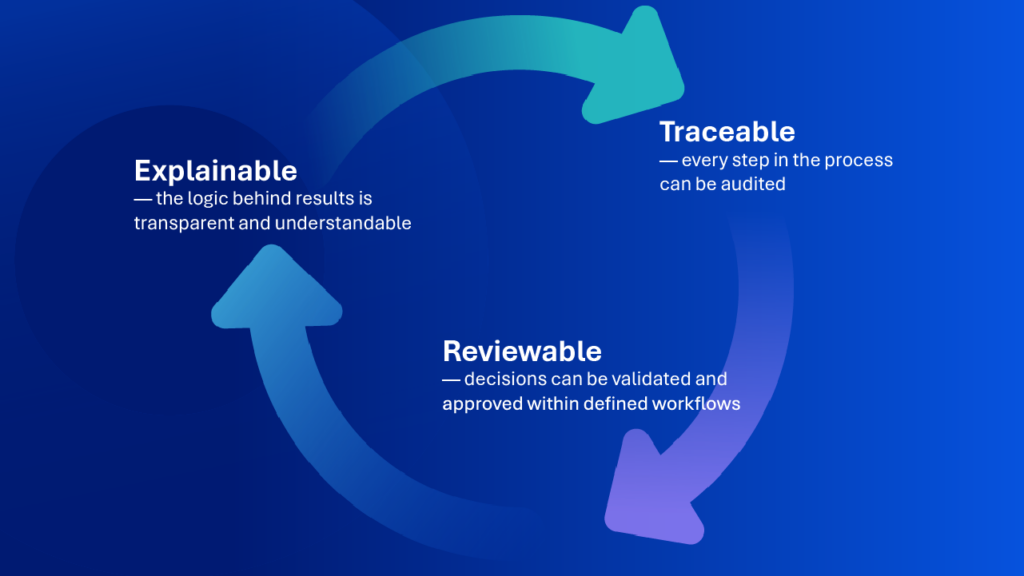
Explainable
Finance teams must be able to understand why a result was generated. Whether AI proposes a journal entry, identifies an exception, or flags a potential risk, the reasoning behind the output must be transparent and understandable.
Traceable
Every step in the process must be auditable. Organizations need visibility into the data used, the actions taken, and the decisions made throughout the workflow. If an auditor asks how a result was produced, there must be a clear answer.
Reviewable
Human oversight remains critical. AI can accelerate execution, but decision ownership does not transfer to technology. Results must be reviewed, validated, and approved within established workflows before they become part of the financial record.
Together, these capabilities ensure AI operates within the same control environment finance teams already depend on. They create confidence that results can be validated, challenged, approved, and defended when necessary.
Without these characteristics, AI may improve efficiency, but it cannot support the level of accountability required for financial reporting.
Accountability Is Still Human
AI has the potential to transform finance operations. It can reduce manual effort, accelerate workflows, and help teams focus more of their time on analysis and decision-making.
What it cannot do is assume responsibility for financial outcomes.
That responsibility remains with finance leaders.
The organizations that successfully scale AI won’t be the ones that automate the most processes. They’ll be the ones that ensure every AI-driven outcome remains explainable, traceable, and reviewable.
Because in finance, trust isn’t built on speed alone. It’s built on accountability.