Trintech Flux Agent
Understand Financial Movement Before It Impacts the Close
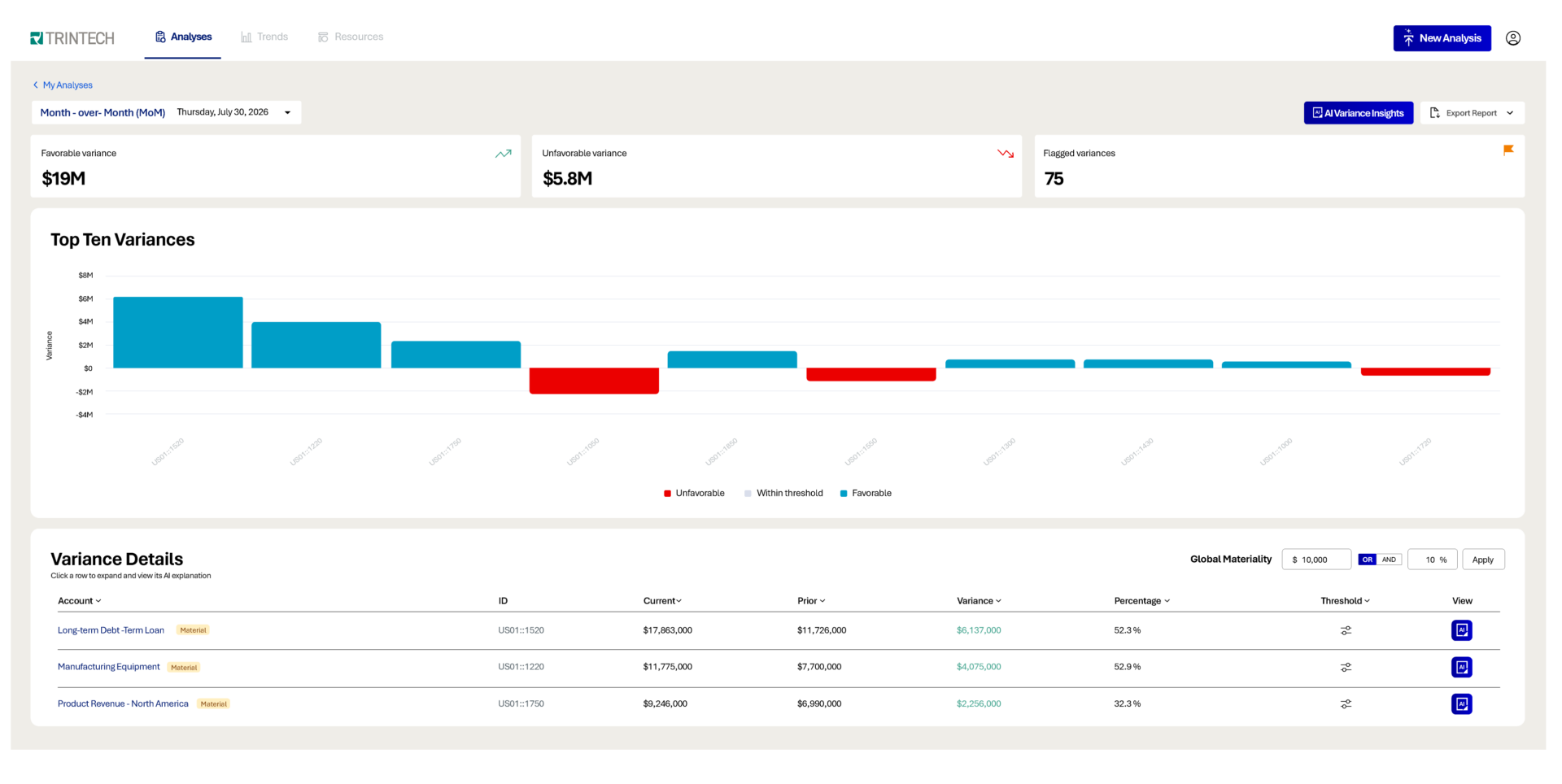
Trintech Flux helps finance teams analyze and explain period over period financial movement across accounts, entities, currencies, and reporting hierarchies.
With embedded AI and automated analysis, accounting teams can identify meaningful changes earlier, validate balances faster, and improve confidence in financial reporting.
Financial Movement Analysis Is Critical to the Close
Every accounting close depends on understanding what changed across the financial statements. Finance teams must investigate fluctuations caused by operational activity, currency impacts, consolidation adjustments, entity-level performance changes, reclassifications, journal entries, intercompany activity, and timing differences — and traditionally, this work is highly manual, performed through spreadsheets, disconnected reports, and repetitive account reviews.
Trintech Flux modernizes this process with centralized analysis, embedded AI assistance, and governed workflows that help teams explain movement faster and with greater consistency.
Built for the Financial Close Lifecycle
Flux analysis occurs early and throughout the close lifecycle because accounting teams must understand whether balances and movements are reasonable before final reporting and certification. Trintech Flux helps organizations identify unexpected financial movement, explain balance fluctuations earlier, validate consolidated reporting results, detect anomalies before close completion, improve reviewer readiness, and reduce manual account investigation. Together, these capabilities provide the foundational understanding of what changed in the financials before deeper variance review and executive analysis occur.
Analyze Period-over-Period Movement Faster
Trintech Flux automatically evaluates movement across financial periods to help accounting teams quickly identify significant balance changes, unusual account fluctuations, entity-level movement, currency impacts, consolidation adjustments, unexpected trends, and high-risk accounts requiring review. Instead of manually comparing reports and spreadsheets, teams gain structured and explainable movement analysis within a centralized workflow.
Understand Movement Across Complex Organizations
Large organizations operate across multiple entities, currencies, and reporting structures. Trintech Flux helps finance teams analyze movement across legal entities, business units, cost centers, reporting hierarchies, currencies, regions, and both consolidated and unconsolidated balances — allowing teams to isolate movement drivers and investigate financial changes at the appropriate level of detail.
Detect Anomalies Earlier
Embedded AI helps accounting teams identify unusual financial movement patterns that may indicate posting errors, incomplete accruals, timing inconsistencies, unexpected operational changes, reclassification issues, consolidation anomalies, or intercompany discrepancies. By surfacing these anomalies earlier, finance teams can reduce late-stage close risk and improve reporting confidence.
Improve Reviewer Readiness
Flux analysis is a critical component of account review and close validation. Trintech Flux streamlines reviewer workflows by providing standardized movement explanations, threshold-based review processes, supporting documentation workflows, reviewer signoffs, AI-assisted narrative generation, and audit-ready evidence retention — so reviewers spend less time gathering information and more time validating financial accuracy.
Support Audit and Compliance Requirements
Accounting teams must demonstrate that material movements were reviewed, investigated, and appropriately explained. Trintech Flux supports governance and compliance through complete audit trails, documented movement explanations, reviewer accountability, workflow transparency, materiality thresholds, supporting evidence management, and controlled review processes — ensuring every movement review is traceable and defensible.
How Trintech Flux Works
1. Analyze Financial Movement
The platform compares balances and activity across periods, entities, and reporting structures.
2. Surface Material Changes
Significant movement and unusual fluctuations are identified automatically.
3. Investigate Drivers
Teams drill into entity, account, and transaction-level detail.
4. Review and Explain
Accounting teams document explanations and supporting rationale.
5. Approve and Retain
Reviewer signoffs and supporting evidence are maintained for governance and audit readiness.

Business Outcomes
Accelerate the Close
Reduce time spent manually analyzing balance movement.
Improve Financial Confidence
Ensure material fluctuations are understood and explainable.
Detect Issues Earlier
Identify anomalies before they become reporting problems.
Strengthen Governance
Maintain standardized and auditable review workflows.
Improve Reviewer Efficiency
Centralize supporting evidence and movement analysis.
Flux Analysis Built for Accounting Teams
Trintech Flux is built for the accounting close lifecycle. Unlike standalone analytics tools, it embeds financial movement analysis directly into governed accounting workflows — combining AI-assisted analysis, financial controls, workflow governance, reviewer accountability, and audit-ready documentation within a single close platform.