
Trintech vs. LLMs & Generative AI Assistants
Smart Conversations. Not a Close Platform.
ChatGPT, Claude, Copilot, and other generative AI assistants are strong at reasoning, writing, and answering questions.
But the financial close isn’t a conversation. It’s a controlled, auditable process with regulatory consequences.
A chat window isn’t where you want your books to live.
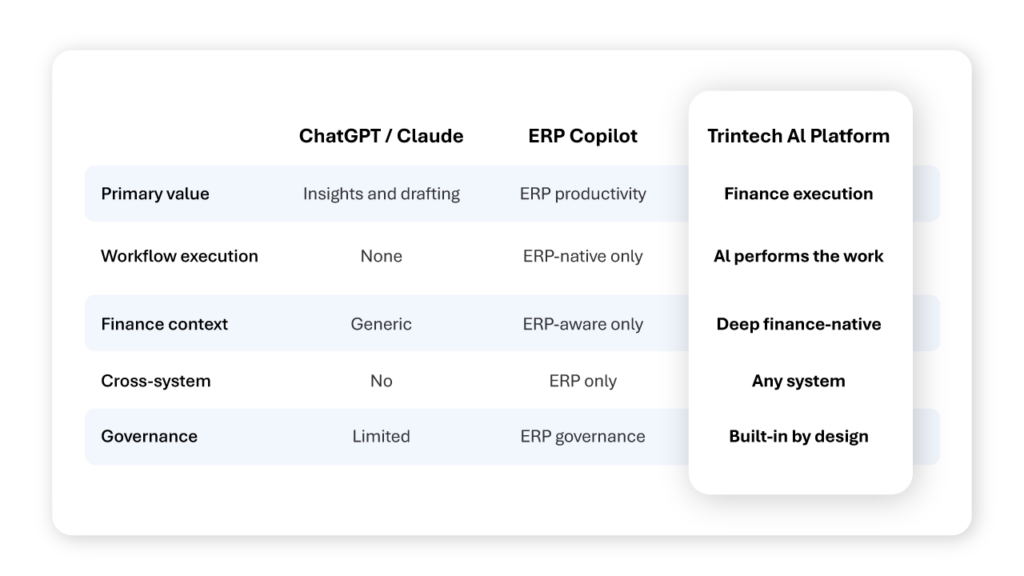
Direct Comparison
The “We Already Have AI” Problem
Every CFO conversation now includes it: “We’re already using AI.”
Teams use ChatGPT, Claude, or Gemini for drafting and analysis, and that productivity is real. But “using AI” now covers everything from writing a memo to closing the books, and those are not the same problem.
The financial close is regulated, audited, and business critical. According to IDC’s April 2026 CFO survey (N=520), the top two barriers to AI adoption in finance are data quality, cited by 58% of CFOs, and AI governance, cited by 52%. ChatGPT doesn’t solve either of those. Trintech does.
What Generic AI Gets Right…and Where it Ends
ChatGPT and Claude are genuinely useful for finance teams: drafting commentary, summarizing reports, thinking through analysis. Trintech actually uses LLMS as a component inside the Trintech AI Platform.
The question isn’t whether LLMs are capable. It’s what they’re connected to and what governs them.
Generic AI tools don’t have:
- Secure connections to your ERP, banking data, or subledgers
- Knowledge of your chart of accounts, materiality thresholds, or entity structure
- Any workflow, approval chain, or review routing
- Audit trails, segregation of duties, or role-based access
- Finance-specific logic that understands how the close actually works
Every session starts from zero. That works for summaries, not for an audited close.

Finance-Native AI vs. General-Purpose AI
Trintech AI is embedded inside governed close workflows, connected to your actual financial data, with human review and audit logging on every step. It doesn’t just generate outputs. It executes work inside the close.
Trintech isn’t a smarter ChatGPT pointed at finance. It’s a purpose-built execution layer for the close.
What Trintech AI Actually Executes
Trintech’s agents don’t summarize data. They do the work.
Trintech Variance Analysis Agent
Trintech Variance Analysis Agent pulls transaction details, compares to prior periods, and generates structured variance narratives with supporting evidence.
Trintech Flux Agent
Trintech Flux Agent analyzes period-over-period movement across accounts, entities, currencies, and reporting hierarchies automatically, surfacing significant changes and anomalies before deeper review begins.
Trintech Exception Management Agent
Trintech Exception Management Agent automates detection, classification, and risk-based prioritization end to end. Staff accountants work from a prioritized queue instead of sorting a spreadsheet.
The Audit Conversation
At some point, your external auditors will ask: how was this variance explained? Who reviewed it? What data was it based on? When was it approved?
If the process ran through a chat tool, you don’t have clean answers to any of those questions. Someone has to reconstruct the traceability manually after the fact, which usually takes longer than the automation saved.
Trintech outputs are audit-ready by construction.
- Variance explanations include the underlying movement data
- Exception resolutions include classification logic and the reviewer’s decision
- Journal entries include source documentation and sign-off
- Every AI action is logged automatically
The CFO cannot be almost right. Every number has to be explainable, traceable, and defensible, and that’s what Trintech is built to deliver.

What About Enterprise ChatGPT, Copilot, or Your ERP’s AI?
Enterprise ChatGPT / Claude tiers address data privacy and retention, which matters. But the fundamental gap isn’t security, it’s workflow. There’s still no ERP connection, no audit trail, and no reconciliation governance regardless of which tier you’re on.
Microsoft Copilot in Office is useful for working in documents and genuinely worth using. It’s not a financial close platform, and Trintech doesn’t replace it. Copilot lives in documents and analysis. Trintech lives in close execution and governance, and most customers use both.
ERP AI agents validate the market direction. ERP agents are valuable because they sit close to the system of record, and Trintech complements that by executing the close work that extends beyond ERP boundaries: banking data, multi-system reconciliations, exception workflows, and accruals that span more than one platform.

Frequently Asked Questions
Can’t we build this ourselves?
You probably can build a prototype. The challenge is production. Finance AI has to be governed, repeatable, explainable, integrated, permissioned, monitored, and audit-ready. Trintech gives you the finance domain logic and workflow execution layer without requiring your team to become an AI product company.
Why not just use ChatGPT with a strong prompt?
Prompt engineering solves a communication problem. Governed financial close execution is an infrastructure problem, and you still have no ERP connection, no audit trail, no approval chain, and no reconciliation workflow underneath you.
Why not just use ChatGPT or Claude for reconciliations?
While ChatGPT and Claude are useful for productivity and analysis, Trintech is built to execute finance work inside the close and reconciliation process. AI tools cannot:
- Connect to your ERP (or multiple systems) securely
- Maintain workflow approvals
- Enforce segregation of duties
- Provide audit-ready documentation
- Log AI decisions
With Trintech, workflow context, data traceability, human review, approvals, and auditability are part of the model—not something the team has to build around it.
What about the enterprise version of these tools?
Enterprise tiers improve data privacy and retention, which matters. But the gap is workflow, not security. There’s still no governed close execution, no audit documentation, and no exception management built in.
We’re already using Copilot. Is this different?
Yes. Copilot is a productivity tool for working in documents. Trintech is where close execution and governance live, and most customers end up using both.
Is Trintech using LLMs too?
Yes, as one component. LLMs power explanation and generation inside agents like Variance Analysis. The difference is the model runs inside a governed financial close workflow, connected to your actual data, with human review and audit logging on every step rather than in a chat interface where the output lives in a thread.
What if the AI is wrong?
Every Trintech AI output is reviewed by a human before anything is finalized. Reviewers accept, edit, or reject, and that decision is logged. Nothing gets posted without an approval attached to it, so when the AI is wrong, the reviewer catches it before it matters.
AI outputs can hallucinate. Why should we trust Trintech AI?
That’s exactly why finance AI cannot be a black box. Trintech’s approach is built around explainability, evidence, review, and governance. Every Trintech AI output is traceable to source data and routes through your existing approval workflow. The goal is to accelerate work while keeping finance in control—not to blindly accept an AI answer.