Finance leaders already know that AI is only as good as the data behind it. But clean data alone doesn’t make an organization AI-ready.
Think of your data like clean water. Its quality at the source matters, but so does the system it travels through. Even clean water can become compromised as it moves through poorly maintained pipes and uncontrolled connections. Financial data faces a similar challenge as it moves through integrations, transformations, reconciliations, approvals and, increasingly, AI-enabled workflows. Every handoff is an opportunity to either preserve or compromise its integrity.
That’s an important takeaway from COSO’s 2026 Achieving Effective Internal Control Over Generative AI guidance. COSO’s GenAI guidance makes clear that trustworthy GenAI requires more than quality inputs. Organizations also need the controls, context, traceability and accountability to keep data trustworthy from source to decision—and to put AI to work with confidence.
What Does the COSO Framework Say About GenAI?
The COSO framework remains applicable to GenAI, but organizations need to adapt how they apply its principles to address the unique risks AI introduces.
The COSO framework’s five components—Control Environment, Risk Assessment, Control Activities, Information and Communication, and Monitoring Activities—still provide the foundation. GenAI changes the environment in which those controls operate. Unlike traditional deterministic technologies, GenAI is probabilistic, meaning its outputs at times can be confidently wrong. It is also dynamic, with models, prompts and retrieval data that can change frequently, requiring controls and monitoring to keep pace.
Perhaps most important for Finance, GenAI is highly scalable. AI can rapidly scale quality and efficiency, but it can just as easily scale errors and bias. COSO’s guidance therefore emphasizes designing controls that prevent an isolated problem from propagating into a systemic one.
Those principles become especially important when applying COSO’s GenAI guidance to financial processes and data.
AI can rapidly scale quality and efficiency, but it can just as easily scale errors and bias.
Why Isn’t Clean Data Enough for Finance AI?
Clean data can still lose trustworthiness as it moves through financial processes—and that matters when applying the COSO framework to AI-enabled finance. Accurate information at the source can be compromised by mapping errors, uncontrolled transformations, outdated inputs, configuration changes or a lack of traceability into how an AI-generated output was produced.
COSO specifically warns that weaknesses in data ingestion can propagate downstream, while errors introduced during transformation and integration—such as an incorrect mapping that assigns otherwise accurate transactions to the wrong account—can silently affect large volumes of data. Its guidance emphasizes preserving provenance, controlling changes and maintaining enough information to understand how data moved from source to output.
For Finance, that means data quality needs to extend beyond accuracy at a single point in time. As financial data moves between systems, reconciliations, journals, approvals and reporting processes, organizations need to preserve its context and integrity along the way.
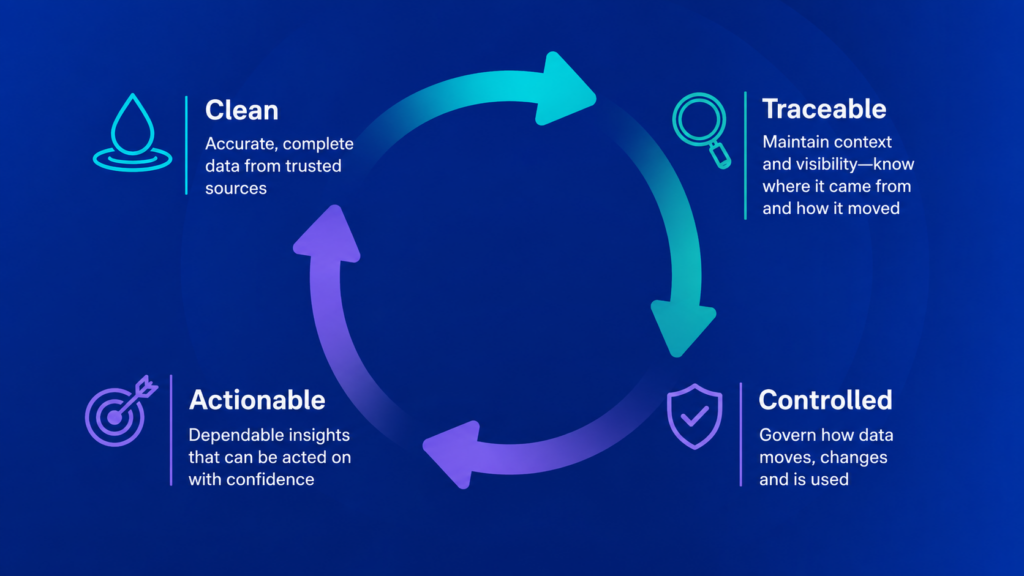
A useful way to think about AI-ready financial data is:
Clean data provides the starting point. Traceability establishes where it came from and what happened to it. Controls govern how it moves, changes, and is used. Only then can Finance confidently turn that data—and the AI-powered insights derived from it—into action.
How Can Finance Apply the COSO Framework to AI-Enabled Processes?
COSO’s guidance points to several ways finance teams can maintain data integrity as information moves through AI-enabled processes. Three are particularly relevant to the financial close:
1. Preserve context and traceability. Knowing that data is accurate isn’t enough if teams can’t determine where it came from or how an AI-generated result was produced. COSO recommends retaining information appropriate to the use case, including sources, inputs, outputs, prompts, model or configuration versions and confidence scores. For Finance, that traceability becomes increasingly important when AI contributes to reconciliations, journal entries, analyses or other work subject to review and audit.
2. Control how data moves and changes. Integrations and transformations are part of the control environment, not simply mechanisms for moving information. COSO recommends controls around transformation rules, testing, approvals, reconciliation and data lineage so that errors introduced between systems can be detected before they affect downstream processes.
3. Put controls around what AI does with the data. The level of human review and control should reflect the risk of the action. COSO offers the example of a GenAI reconciliation agent that automatically posts only when a validated confidence threshold is met and no policy exceptions are triggered. Everything else is routed to a human reviewer with the context needed to investigate. Changes to the threshold are also subject to approval and ongoing monitoring.
The principle extends beyond reconciliation: as AI assumes more responsibility within financial processes, people remain accountable for defining where it can act, when intervention is required and how its outputs are validated and monitored.
Clean Data Is the Starting Point, Not the Finish Line
Like clean water, financial data depends on more than its quality at the source. The systems, controls and people it encounters along the way determine whether it remains dependable when it reaches its destination.
COSO’s GenAI guidance reinforces a broader lesson for finance leaders: AI readiness requires more than data readiness. Organizations also need connected processes, embedded controls, clear accountability and appropriate human oversight to put that data—and AI—to work with confidence.
Trintech’s white paper, AI Moves Fast. Your Financial Close Has to Catch Up, takes that conversation further. Explore how to build the connected, uniform and controlled operating foundation your financial close needs to move beyond AI adoption and toward meaningful transformation.
Written By: Lindsay Rose, Senior Manager, Content Marketing
AI Moves Fast. Your Financial Close Has to Catch Up
Download Trintech’s white paper for a deep dive on this topic.