How to Choose Intercompany Accounting Software
Blog post
Share
As organizations grow through acquisitions, global expansion, and increasing transaction volumes, spreadsheets and ERP-native functionality often become difficult to scale. Dedicated intercompany accounting software helps accounting teams standardize processes, automate reconciliation, and improve visibility across the financial close.
But not every solution offers the same capabilities. Here’s what accounting teams should evaluate when selecting intercompany accounting software.
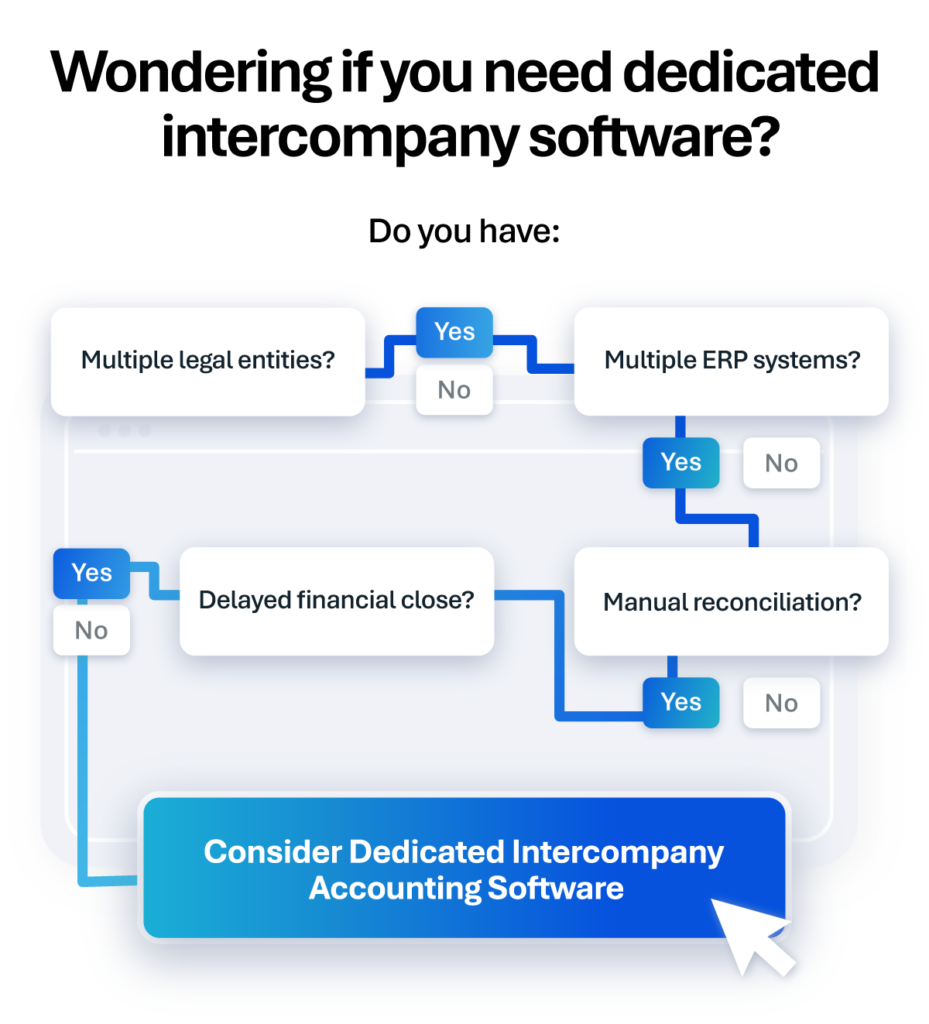
Do You Need Dedicated Intercompany Accounting Software?
Not every organization needs dedicated intercompany accounting software. If your company has only a few legal entities, processes a relatively small number of intercompany transactions each month, and operates from a single ERP system with standardized accounting processes, your existing ERP and manual reconciliation procedures may be sufficient to manage the workload.
However, that often changes as organizations grow.
Consider an organization that acquires three companies over five years. Each acquisition brings its own ERP system, chart of accounts, accounting policies, and financial close processes. What was once a straightforward reconciliation between two entities becomes hundreds—or even thousands—of intercompany transactions spanning multiple business units, currencies, and accounting teams. Accounting teams now spend significantly more time matching transactions, investigating discrepancies, and preparing eliminations before they can close the books.
Dedicated intercompany accounting software becomes valuable when manual processes begin slowing the financial close or limiting visibility across entities. Purpose-built solutions help accounting teams automate repetitive work and manage growing intercompany complexity more efficiently.
Can Your ERP Handle Intercompany Accounting on Its Own?
Most ERP systems include basic intercompany accounting capabilities, allowing organizations to record transactions, maintain financial records, and support financial consolidation.
However, as intercompany activity becomes more complex, many organizations find they need additional capabilities for reconciliation, workflow, governance, settlement, and visibility.
| ERP Systems | Intercompany Accounting Software |
| Records intercompany transactions | Automates matching and reconciliation |
| Maintains financial records | Standardizes workflows across entities |
| Supports the general ledger | Improves visibility into exceptions |
| System of record | Supports settlement, netting, and eliminations |
The ERP remains the system of record, while dedicated intercompany accounting software helps accounting teams manage the operational complexity of the financial close.
What Features Should You Look For?
The best intercompany accounting software doesn’t just automate individual tasks—it should simplify the entire intercompany accounting process. As you evaluate solutions, look beyond feature lists and consider whether the software solves the operational challenges your accounting team faces every month.
Can It Scale Across Multiple Entities and ERP Systems?
Look for software that standardizes intercompany accounting across multiple entities and ERP systems without requiring every business unit to change its existing processes.
Does It Reduce Manual Reconciliation?
The right solution should automatically match transactions, surface exceptions, and help accounting teams focus on investigating discrepancies instead of manually comparing records.
Does It Improve Visibility and Accountability?
Look for centralized dashboards, workflow management, and audit trails that make it easy to track transaction status, assign ownership, and resolve issues before they delay the financial close.
Does It Support the Entire Intercompany Process?
Many solutions focus only on reconciliation. Consider whether the software also supports transaction management, intercompany settlement and netting, eliminations, and financial controls as part of a connected financial close process.
Is It Built for Long-Term Growth?
Choose software that scales with transaction volumes, acquisitions, and organizational growth without increasing manual effort.
Does It Strengthen Financial Governance?
As intercompany accounting grows more complex, strong governance becomes just as important as automation. Look for software that embeds financial controls, standardizes approvals, and provides a complete audit trail, so every transaction remains transparent, traceable, and reviewable.
Is It Time to Upgrade Your Intercompany Accounting Process?
It may be time to consider dedicated software if:
- Intercompany reconciliation consistently delays the financial close.
- Accounting teams rely heavily on spreadsheets and email to manage transactions.
- Multiple ERP systems make reconciliation increasingly manual.
- Acquisitions have introduced new entities and accounting processes.
- Intercompany discrepancies require significant investigation each month.
Intercompany Software Evaluation Checklist
Before selecting a solution, ask whether it can:
✓ Automate reconciliation
✓ Reduce manual work
✓ Improve visibility across the financial close
✓ Strengthen financial governance
✓ Scale across multiple legal entities
✓ Integrate with your ERP systems
✓ Support future acquisitions
Why Organizations Choose Trintech
Organizations choose Trintech because intercompany accounting is more than just reconciliation. Trintech helps accounting teams standardize workflows, automate transaction matching and reconciliation, support settlement, netting, and eliminations, and strengthen financial governance across the financial close. Combining automation with embedded financial controls, Trintech enables accounting teams to reduce manual effort, improve reporting accuracy, and scale intercompany accounting with confidence.
Whether you’re managing multiple ERP systems, integrating newly acquired entities, or looking to accelerate the financial close, Trintech provides the visibility, control, and automation needed to simplify even the most complex intercompany accounting environments.
Written By: Lindsay Rose, Senior Manager, Content Marketing