
Guide to Transaction Matching

Solving the Transaction Matching Puzzle
Manual transaction matching can feel like putting together a puzzle where you KNOW a bunch of pieces are missing, particularly when you know you may be dealing with tens of thousands, even hundreds of thousands, of transactions in a particular period. Missed, misposted, or otherwise mishandled transactions can delay EOM closing, cause compliance headaches, and erode stakeholder confidence in your operations.
This is exactly why fast, efficient, and accurate transaction matching is crucial. In this guide, we’re going to get down to the basics to understand what transaction matching is and the specific challenges that finance teams can face. You’ll learn how automated transaction reconciliation can solve them in minutes, and why Trintech’s solution is leading the industry with innovation and accuracy at scale.
Table of Contents
- What Is Transaction Matching?
- Why is Transaction Matching Important?
- What are the Challenges of Manual Transaction Matching?
- How Does Transaction Matching Work?
- What are the Benefits of Transaction Matching?
- What are the Types of Transaction Matching?
- What are Common Use Cases for Transaction Matching?
- Transaction Matching Success Stories
- How to Get Started with Transaction Matching Tools?
- How Trintech Helps with AI-Powered Transaction Matching
Recommended Content
Restaurants: Manage 3rd-Party Reconciliations with Ease
Transaction-Level Matching: The Key to Effective Reconciliation for Banks & Credit Unions
Transaction Matching Best Practices for Retailers
What is Transaction Matching?
Transaction matching is the orderly, even systematic, comparison of multiple data sources to confirm that each event is recorded accurately on each system. This typically includes bank statements, accounts receivable sub-ledgers, and more.
A “match” is typically achieved when predefined attributes all align close enough to be considered within tolerances. In most cases, the major attributions include date, time, amount and reference number. Unmatched items become exceptions that are flagged for further manual investigation before the account can be certified.
Unlike broader account reconciliation methods, which might examine balances at a higher, summary level, transaction matching operates at a line-item detail level. This means it removes one of the major causes of balance differences instead of masking them with journals.
Why is Transaction Matching Important?
Transaction matching is a vital part of the financial close process which facilitates detecting errors, missing data, and potential fraud well before the month-end reports are finalized. Without this systematic matching process, misposted or unrecorded entries have the potential to cause misstated balances.
Automated matching helps accelerate the closing cycle, freeing up teams from manual checks and empowering them to investigate exceptions. Automated matching can cut time spent on matching transactions by as much as 80%. In more high-volume environments like larger enterprises or financial institutions, effective and accurate matching is a critical part of maintaining quality control, meeting regulatory requirements and deadlines, and giving clients and stakeholders confidence in accurate and timely financials.
What are the Challenges of Manual Transaction Matching?
The days of spreadsheet reliance and human-powered month-end reconciliation are long gone. The entire matching process is slow and invites mistakes at every stage. Manual matching struggles to scale for volume during the odd, heavy month, bottlenecking potential growth when it’s needed the most.
Inconsistencies with rules applied by humans, like subjective date tolerances, rounding errors and more, can all require constant adjustments and reworks. Differences in date formats can exacerbate this issue from one platform or system to another if data needs to be transformed.
As this transaction volume and complexity grow, implementing partial payments, chargebacks or intercompany transfers can lead spreadsheets to their practical limits, making manual investigation unsustainable.
Demo: Adra Matcher Demo On-Demand
See how Adra Matcher brings simplicity to your matching process through automated high-volume, multi-way transaction matching, and exception management.
How Does AI-Powered Transaction Matching Work?
Automated transaction matching is more detailed than you may realize, but it can be broken down into a few key steps.
First, the transaction matching software imports all of the needed data and transaction files from various sources, like ERP ledgers, credit card feeds, bank statements and so on, normalizing the data as it goes. Next, various sets of matching rules are applied to that data in sequenced order, matching easy pairs based on dates, amounts, reference values, or other criteria.
However, when there are exceptions that don’t meet the criteria and cannot be matched, they are flagged for manual review. This can be incredibly complex and require substantial human research and review before finding matching data from fragmented systems.
AI-powered matching takes it a step further, taking those exceptions that don’t meet your rules criteria and running it through its own checks. Using machine learning, AI can spot patterns over time and suggest more matches and rules that you may have overlooked. By suggesting more matches, the human always has the final say and control, but the AI has been able to spot far more complex matches , freeing up finance professionals to focus on investigating exceptions rather than manual data entry.
What are the Benefits of Automated Transaction Matching?
- Scalability: Automation completes matching in minutes, not days, shrinking the financial close cycle.
- Efficiency gains: Algorithm-driven rules reduce human error and catch discrepancies that manual review may miss.
- Improved accuracy: High volume matching handles thousands of transactions without added headcount.
- Audit readiness: Detailed audit trails document every match and exception, simplifying regulatory compliance reviews.
What are the Types of Transaction Matching?
Cadency Match – Integrated High Volume Matching
With Cadency Match, the office of finance can perform high-volume transaction matching as part of a comprehensive approach to the Record to Report process – rapidly enhancing the accuracy and regulatory compliance of all resulting financial statements. The solution’s exception management capabilities apply multiple match rules to quickly reduce the time required to match transactions daily, allowing for exceptions to be handled in a timely manner instead of leaving it all to period end.
What are Common Use Cases for Transaction Matching?

Bank Reconciliation
Financial institutions use it for automatically pairing daily bank statement lines with ledger entries to close books quicker.
Credit Card Reconciliaiton
Matching can help align card processor fees with expense records, quickly identifying fraudulent or duplicate charges.
Intercompany Reconciliation
Easily match transactions spanning legal entities to simplify consolidation and reduce imbalances.
AP/AR Matching
Reconcile customer payments with vendor invoices to keep receivables and payables reporting accurate.
Transaction Matching Success Stories
It might be challenging to get a clear idea of what automated transaction matching software can do for your team. Here are a few scenarios where transaction matching has substantially improved month-end operations.
This restaurant group transformed its reconciliation process by implementing Trintech to automate daily transaction matching across bank, A/R, gift card, and corporate card activity. By moving off manual Excel spreadsheets, they cut cash reconciliation time from over three weeks to just 2–3 days—nearly a 90% improvement—and cut their close time in half. This automation eliminated reliance on third parties, reduced errors, enhanced visibility for auditors, and allowed staff accountants to handle tasks once reserved for the CFO—saving time and money while enabling the finance team to focus on strategic work as the business doubled in size.
CNG Holdings, handling roughly one million monthly transactions, dramatically improved its transaction matching by implementing Trintech’s automated solution. Moving off Excel and onto a powerful database-driven system, they now auto-match 97% of transactions—saving extensive manual effort—reducing their cash reconciliation team from 25–30 people to just nine, and minimizing charge-offs. This automation also streamlined audits, producing zero auditor observations, increased visibility into exceptions, and enabled the team to focus on strategic work—all thanks to Trintech’s unmatched high-volume matching capabilities.
H&R Block, processing over 200,000 transactions monthly—ramping up to more than a million credit card transactions during peak season—significantly bolstered its high-volume transaction matching by integrating Trintech’s solution with Workday. After discovering Workday’s account-certification module lacked depth, they chose Trintech for its powerful automated matching capabilities, enabling them to efficiently match hundreds of thousands of transactions each month, streamline balance sheet reconciliations, and accelerate their financial close. The result: stronger visibility, smooth audit cycles with integrated SOX controls, and resounding positive feedback from the accounting team, making Trintech “exactly what the doctor ordered.
How to Get Started with Transaction Matching Tools?
Start off by mapping all of your data sources, like bank feeds, ERP systems, and credit card transaction files. Once these sources are mapped to your matching platform, you’ll define the basic rules that will dictate matches, then pilot the operation with a small subset of data or accounts.
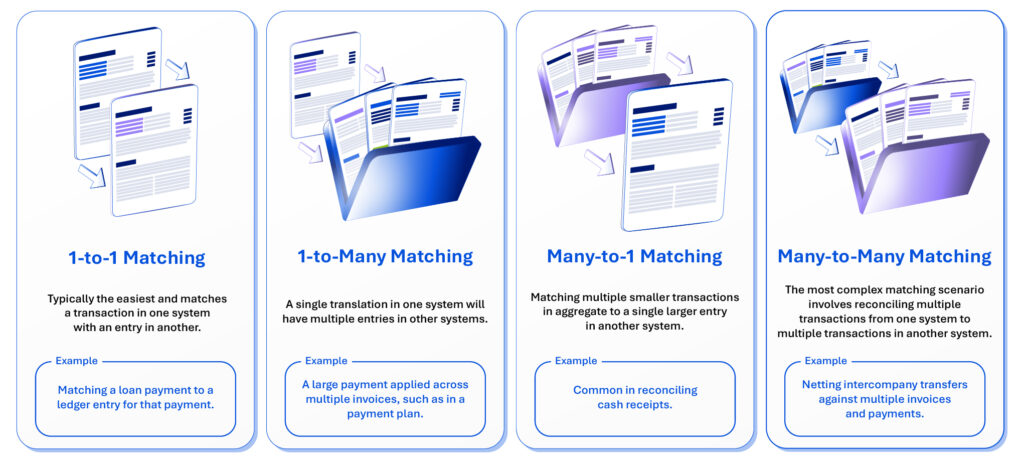
As you see patterns emerge, review and refine your exception rules. Train your team on the dashboard workflows that dictate investigation of flagged entries, and as confidence grows, expand the rule complexity to cover more 1tomany and manytomany scenarios.
Finally, integrate the matching processes into your month-end closing checklist to maintain consistency and continuous improvement.
How Does Trintech Help with AI-Powered Transaction Matching?
Trintech’s automated solution handles high-volume transactions and complex matches that far outpace any other transaction matching tools on the market, most which can only handle 1-to-1 matching. With support for 1-to-1, 1-to-many, many-to-1, and many-to-many rules natively, manual interventions can be all but phased out.
Using Machine Learning (ML) and GenAI, Trintech’s powerful AI models can suggest additional matches and provide risk ratings for suspected issues. All of this can be produced daily, so the number of matches and flagged issues you have to manually investigate is reduced significantly. With end-to-end audit trails and real-time dashboards, finance teams can get far more visibility into and control over the entire close process.